
For decades, officers and clinicians have been trained that certain behaviors predict imminent violence. Boxer’s stance. Pacing. Avoiding eye contact. The problem: most of that training was built on intuition, not evidence. The sources said “scientific research” but cited nothing. A landmark 2013 literature search by Johnson and Aaron found the empirical literature on interpersonal behavioral predictors of imminent violence was virtually nonexistent.
That has slowly changed. A small but rigorous body of research now exists. Some cues have been validated. Others have been definitively debunked. And one new system—FOCUS—is applying that science to real-time decision-making in ways the research always pointed toward but never achieved.
| “No patient became violent without first displaying at least one behavioral cue.” — Roy (2013), n=1,572 ER patients |
The Research: What Was Actually Studied
The studies reviewed here share a critical characteristic: violence was the outcome variable, and it occurred during the same encounter in which cues were observed. These are not studies of long-term risk or historical profiles. They are studies of behavior in the minutes—or seconds—before violence erupted.
1. Arsenio et al. (2000) — The Foundational Study
Journal of Child Development | Preschool observational study, n=51
The earliest rigorous attempt to link specific observable cues to actual physical violence. Researchers directly observed preschoolers and measured aggression as deliberate biting, kicking, or hitting. They found that a cluster of cues—increased voice volume, negative verbal attacks, narrowed eyelids, lowered brows, pressed lips, tensed posture, and clenched fists—predicted 44% of the variance in violent behavior. The cue cluster, not any single behavior, carried the predictive weight.
2. Wilkes et al. (2010) — The Nurse Panel Study
Emergency room nurses, Delphi focus groups, n=11
Eleven ER nurses evaluated 37 potential behavioral indicators across multiple rounds of structured focus groups. This was a perception study, not a validation study—its value was generating a scientifically refined list of candidate cues for testing. The Wilkes instrument became the foundation for the Jackson and Roy studies that followed.
3. Jackson et al. (2014a) — Hospital ER Observation
Collegian, 21:65–70 | n=220 ER patients, 36 became violent
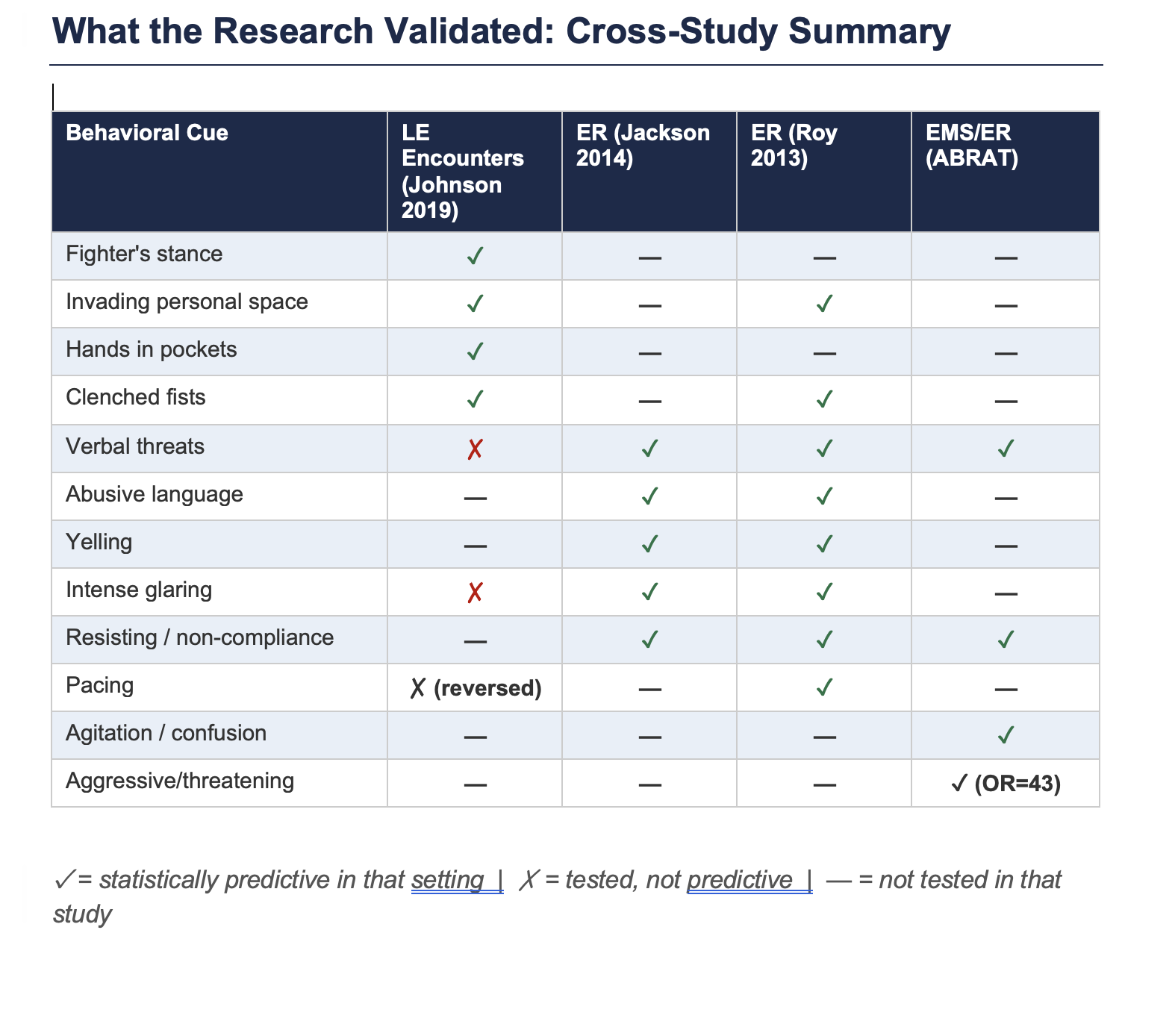
Researchers directly observed 220 emergency room patients and coded for the Wilkes cue list. Of all 37 candidate cues, only five proved statistically predictive of actual violence during the encounter:
- Verbal threats
- Verbally abusive language
- Yelling
- Intense glaring
- Resisting medical treatment
The majority of cues nurses believed were predictive did not hold up under direct observation. This distinction—between perceived predictors and validated predictors—is central to the entire field.
4. Jackson et al. (2014b) — Hospital Geriatric Ward
International Journal of Older People Nursing, 9:317–323 | Cognitively impaired patients
An observational study in an acute geriatric ward with cognitively impaired patients found that among this population, only pacing reliably predicted physical aggression. No other cue reached significance. This finding demonstrates that cue validity is population- and context-dependent—the same behavior can mean different things in different clinical environments.
5. Roy (2013) — The Most Operationally Significant Hospital Study
Unpublished master’s thesis, Rhode Island College | n=1,572 adult ER patients
Roy’s study produced the most practically significant finding in the hospital literature. Among 1,572 adult ER patients, 3% became violent. Of the 6% who exhibited at least one pre-violence cue, 53% became violent. The landmark finding:
| No patient in the study became violent without first displaying at least one observable behavioral cue. |
The most frequently predictive behaviors among violent patients were verbal threats and abusive language, clenched fists, space violation (walking into the nurses’ station), resisting treatment, yelling, intense glaring, and pacing.
6. Johnson (2019) — Video Analysis of Arrest Encounters
Journal of Police and Criminal Psychology, 34:134–144 | n=174 real police-citizen arrests
The only peer-reviewed study to use actual video of real law enforcement encounters to validate pre-attack cues against actual violent resistance. Using frame-by-frame analysis of 174 matched arrest cases from the reality program Cops, Johnson tested nine behaviors in the minute before physical contact.
| Validated (p < .001 for all four):
• Fighter’s stance • Invading personal space • Hands in pockets • Clenched hands |
A critical secondary finding: several cues showed significantly different patterns across White, Black, and Hispanic subjects. Cue validity was not race-neutral. This has direct implications for both training and legal defensibility.
7. Meehan, Strange & Garinther (2021) — Behavioral Indicators of Concealed Firearms
The Police Journal, 94(4):462–480 | Qualitative, veteran LE interview data
Using interviews and focus groups with experienced officers, researchers identified a lexicon of behavioral cues associated with concealed and unholstered firearm carrying. The identified cues include target glance (looking at the weapon location seconds before reaching), evasive maneuvering, adversarial distancing (moving to a position of tactical advantage), clothing adjustment, hands-in-pockets (holding the weapon steady), and dissociation. The authors explicitly note these cues have not yet been subject to predictive validation—this is a vocabulary-building study that lays the groundwork for future testing.
8. Muchiri, Ateya & Wanyembi (2018) — Gait Analysis of Concealed Firearm Carriers
International Journal of Scientific Research in Computer Science | Skeletal tracking study
A quantitative study measuring gait changes in individuals carrying a concealed firearm tucked at the right hip. Using Kinect V2 skeletal tracking and paired t-tests, researchers identified measurable gait disruptions: right arm abduction, left arm adduction, right leg adduction and extension—extending the previously qualitative findings on disrupted stride and reduced arm swing. This provides measurable, articulable physical parameters for what officers have described anecdotally for decades.
9 & 10. ABRAT-ED & ABRAT-EMS — Kim et al. (2022, 2025)
JACEP Open | ED: n=10,554 | EMS: n=9,024
The largest empirical studies in this body of research. Using prospective cohort designs and logistic regression, Kim and colleagues validated a behavioral risk assessment checklist across emergency departments (10,554 patients across 3 Michigan EDs) and prehospital EMS encounters (9,024 patients across 2 agencies).
In the ED study, the final 7-item tool achieved an AUC of 0.91 (sensitivity 84.3%, specificity 95.3%). In the EMS study, a 3-item tool achieved an AUC of 0.89 with sensitivity 82.9% and specificity 88.1%. The dominant predictor in EMS encounters was aggressive or threatening behavior, with an odds ratio of 43—meaning patients exhibiting this cue were 43 times more likely to become violent.
11. Brøset Violence Checklist — Partridge & Affleck (2018)
Australasian Emergency Care, 21(1):31–35 | n=2,064, scored by security officers
The BVC, applied in an Australian ED by non-clinician security officers, achieved 99.4% specificity at a cut-off score of greater than 2. Patients scoring 3 or above were 71 times more likely to commit a violent act than those scoring below the threshold. The six BVC items—confusion, irritability, boisterousness, physical threats, verbal threats, and attacks on objects—represent one of the most tightly validated cue sets in the literature.
The Problem No Study Solved—Until Now
The research has a consistent structural limitation that the authors themselves acknowledge. Johnson (2019) noted that the behavioral cues in his study were specific to arrest contexts and may vary substantially in schools, prisons, hospitals, or public spaces. Roy (2013)’s hospital findings cannot be directly transposed to a traffic stop. The ABRAT-EMS cannot be applied to psychiatric inpatient settings.
The science was built in silos. Each study validated cues in one context. No system existed to synthesize the validated findings, apply them across environments, account for race-related variation, weight cues by their actual predictive strength, and generate a real-time, articulable risk assessment.
That is the gap FOCUS was built to close.
FOCUS: From Research to Real-Time Decision-Making
FOCUS — Field Observable Cues for Unknown Situations — is the first behavioral risk assessment system built directly on the validated science described in this article. It was developed over five years using the largest sample of officer-involved video ever studied for pre-attack behavioral analysis, with two researchers independently classifying behavior prior to every violent event.